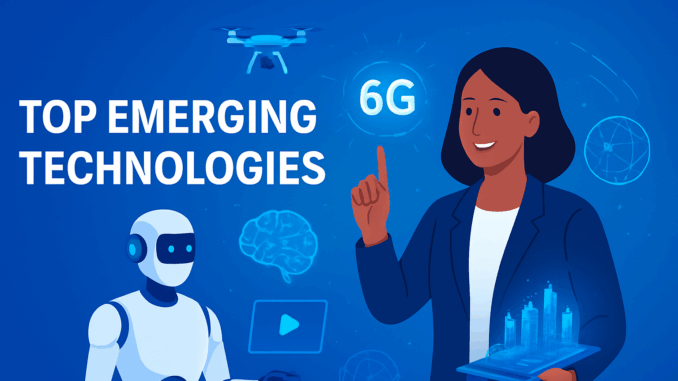
Top Emerging Technologies Shaping the Future of Innovation in 2025
Technology continues to evolve at a rapid pace, and 2025 is shaping up to be a defining year for innovation across industries. Breakthroughs that once felt futuristic—such as autonomous systems, generative AI, quantum insights, and immersive digital worlds—are quickly becoming part of everyday life. Businesses, governments, and individuals are adapting to these advancements, creating new opportunities and challenges. As we look ahead, several technologies stand out as major drivers of transformation. Below, we explore the top emerging technologies shaping the future of innovation in 2025, why they matter, and how they will impact society.
1. Generative AI Becomes a Central Innovation Engine
While artificial intelligence has influenced the digital world for years, generative AI has elevated possibilities to an entirely new level. In 2025, its capabilities extend far beyond text and image creation. Companies are using generative AI to design products, write software, improve medical research, and personalize user experiences.
Why It Matters
Generative AI reduces the time and cost needed to create complex content and systems. It can generate prototypes, automate workflows, and analyze large datasets with unmatched speed. Organizations that integrate generative AI tools are experiencing higher productivity, reduced errors, and improved customer satisfaction.
Real-World Impact in 2025
- Manufacturing: AI-generated product designs help companies test ideas faster.
- Healthcare: AI models assist in early disease prediction and drug formulation.
- Business Operations: Automated AI workflows reduce repetitive tasks and enhance decision-making.
As generative AI becomes more accessible, its influence will extend to small businesses and individual creators, making it one of the most transformative technologies of the year.
2. Quantum Computing Advances Toward Practical Use
Quantum computing has long been seen as a theoretical breakthrough rather than a practical tool. However, in 2025, the technology is moving closer to real-world applications. While widely accessible quantum computing is still developing, specialized use cases are emerging, especially in areas where classical computers struggle with complexity.
Why It Matters
Quantum computers operate using qubits, allowing them to process information in ways traditional computers cannot. This means they can solve extremely complex problems—such as molecular simulations, supply chain optimization, and cryptography—much faster.
Real-World Impact in 2025
- Research Laboratories: Scientists use quantum models to test chemical reactions, accelerating drug discovery.
- Cybersecurity: Organizations are preparing for a future where quantum computing could break traditional encryption.
- Logistics: Large companies use quantum algorithms to optimize routes, reducing costs and emissions.
Quantum computing is not replacing classical computing but enhancing it, creating a hybrid environment of advanced problem-solving.
3. 6G Networks Begin Transforming Connectivity
While 5G adoption continues worldwide, 6G research and early development are accelerating in 2025. This next generation of connectivity is expected to be far faster, more reliable, and more energy-efficient. Its potential impact will extend well beyond mobile communication.
Why It Matters
6G networks are designed to support ultra-low latency and exponentially higher data speeds. These improvements enable innovations like remote robotics, interactive holograms, brain-computer interfaces, and massive-scale IoT systems.
Real-World Impact in 2025
- Smart Cities: Millions of connected sensors will improve traffic flow, energy management, and safety.
- Healthcare: Surgeons can use advanced remote tools powered by instantaneous data transmission.
- Entertainment: Holographic displays and immersive VR/AR streaming will become more realistic.
Although widespread 6G adoption may still take time, the groundwork laid in 2025 will shape the future of global connectivity.
4. Robotics and Automation Reach New Levels of Autonomy
Robotic innovation has grown rapidly over the past decade, and 2025 marks a significant leap. Robots are becoming more autonomous, intelligent, and capable of interacting safely with humans. With advancements in machine learning, robotics is becoming essential in manufacturing, logistics, healthcare, and personal services.
Why It Matters
The combination of AI and robotics creates machines that can learn, adapt, and make decisions. This results in higher efficiency, better safety, and reduced operational costs.
Real-World Impact in 2025
- Warehousing: Autonomous robots organize, pack, and move goods 24/7 with minimal oversight.
- Hospital Care: Robotic assistants deliver supplies and support staff in repetitive tasks.
- Home Use: Personal robots assist with chores, eldercare, and home monitoring.
The rise of robotics is not just about automation—it is about collaboration between humans and machines.
5. Extended Reality (XR) Reshapes Digital Experiences
Extended Reality (XR), which includes Virtual Reality (VR), Augmented Reality (AR), and Mixed Reality (MR), is becoming mainstream in 2025. Improvements in hardware, affordability, and content creation have made immersive experiences more accessible than ever.
Why It Matters
XR enhances experiences by merging digital and physical worlds. It is revolutionizing how people learn, shop, work, and socialize.
Real-World Impact in 2025
- Education: Interactive simulations help students understand complex subjects.
- Workplace: Remote collaboration through 3D immersive environments increases productivity.
- Retail: Virtual showrooms and AR try-ons improve customer engagement.
- Gaming: Rich, lifelike digital experiences create new entertainment possibilities.
As more industries adopt XR, it will redefine how we interact with information and environments.
6. Blockchain and Web3 Rebuild Digital Trust
Blockchain technology continues to evolve beyond cryptocurrencies. In 2025, a new wave of Web3 applications is gaining ground, focusing on digital identity, secure transactions, decentralized storage, and transparent governance.
Why It Matters
Web3 technologies give users more control over their data, reduce reliance on centralized platforms, and increase transparency in digital interactions.
Real-World Impact in 2025
- Finance: Faster, more secure transactions and automated smart contracts.
- Supply Chain: Clear visibility into product origins and movement.
- Digital Identity: Secure authentication without relying on traditional passwords.
- Creativity: Artists and creators protect their work through decentralized ownership tools.
Blockchain is becoming an essential layer of digital infrastructure, improving trust and accountability.
7. Biotechnology and Genomics Drive Medical Breakthroughs
Medical science is undergoing a revolution thanks to advancements in biotechnology, gene editing, and genomic analysis. The year 2025 sees rapid growth in precision medicine, personalized treatments, and early disease detection.
Why It Matters
Bio-innovation helps healthcare providers create targeted therapies that improve patient outcomes while reducing side effects. Genetic insights also support prevention strategies rather than reactive treatments.
Real-World Impact in 2025
- Disease Prediction: AI-powered genomic tools forecast health risks accurately.
- Gene Therapies: More effective solutions for rare diseases and chronic conditions.
- Agriculture: Bioengineered crops improve food security and sustainability.
Biotechnology is not just transforming healthcare—it is shaping the future of global health, food systems, and environmental sustainability.
8. Sustainable Tech Becomes a Global Priority
As climate challenges intensify, innovation in green technology is accelerating. Companies and governments alike are investing in sustainable solutions to reduce carbon emissions and protect natural resources.
Why It Matters
Sustainable technology supports environmental goals while also reducing long-term operational costs.
Real-World Impact in 2025
- Clean Energy: Advances in solar, wind, hydrogen, and energy storage lead to more efficient power systems.
- Smart Infrastructure: Buildings use AI to optimize energy usage.
- Electric Mobility: The adoption of electric vehicles and charging networks continues to rise.
- Waste Reduction: New materials and recycling processes enhance circular economy efforts.
Sustainability is now a core pillar of technological advancement.
Conclusion: A Transformative Year for Global Innovation
The technologies shaping 2025 reflect the world’s increasing reliance on smart, connected, and sustainable solutions. From generative AI and quantum computing to robotics, XR, Web3, biotechnology, and green technologies, each advancement is unlocking new possibilities. These innovations are not just improving industries—they are redefining how people live, work, and interact with the world.
As we move deeper into the digital era, the companies, professionals, and communities that embrace these emerging technologies will be best positioned for success. The future of innovation is not decades away—it is happening now, shaping 2025 into one of the most pivotal years for technological progress.