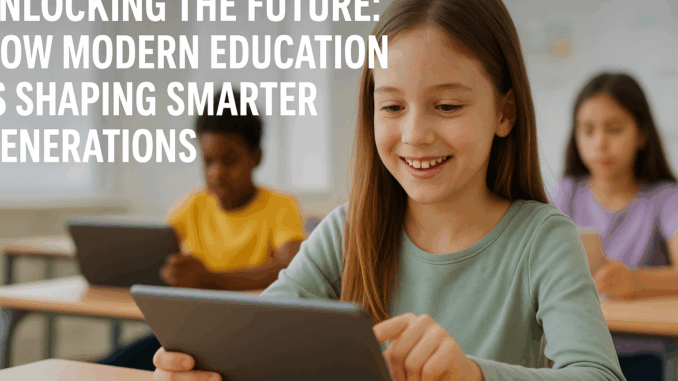
Unlocking the Future: How Modern Education Is Shaping Smarter Generations
Education has always been the foundation of human progress, but today, it is undergoing one of the most transformative periods in history. Driven by technology, innovation, and evolving societal needs, modern education is no longer limited to chalkboards, textbooks, and traditional teaching methods. Instead, it is becoming a dynamic, personalized, and globally connected ecosystem designed to shape smarter and more capable generations. From digital learning tools and artificial intelligence to hands-on problem-solving models and global classrooms, modern education is preparing learners for a future that demands creativity, adaptability, and lifelong learning.
In the past, education mainly focused on memorization and repetition. While these skills were useful in an industrial society, today’s world requires more. Future generations must know how to think, not just what to think. As industries shift toward automation, innovation, and global interaction, modern education is stepping up to the challenge. Let’s explore how emerging trends, technologies, and methods are unlocking the future and building smarter generations.
1. Digital Learning: Bridging Classrooms and Technology
One of the most significant drivers of transformation in modern education is the rise of digital learning. Classrooms are no longer defined by four walls. Students can learn from anywhere and at any time through online platforms, virtual classrooms, and interactive tools.
A. Online and Hybrid Learning Models
Online learning has evolved from a niche concept to a global standard. Schools, universities, and training institutions now offer hybrid models that combine online and in-person instruction. This approach:
- Gives students flexibility
- Provides access to learning resources 24/7
- Helps schools adapt quickly to disruptions
- Encourages self-paced learning
For many students, online platforms offer a safe, comfortable learning environment where they can review lessons repeatedly, ask questions more freely, and access global knowledge.
B. Interactive and Multimedia Learning
Modern education is moving beyond text-based lessons. Multimedia tools such as videos, animations, simulations, and gamified apps help students understand complex concepts easily. Visual learning is more engaging and helps improve retention, especially among younger generations.
Instead of passively listening, students are now participating actively in learning experiences that feel more like exploration than memorization.
2. Artificial Intelligence: Personalizing the Learning Experience
AI is revolutionizing education by offering personalized learning paths tailored to each student’s strengths, weaknesses, and preferences. This is one of the most powerful ways modern education is shaping smarter generations.
A. Intelligent Tutoring Systems
AI-driven tutoring systems analyze student performance and create personalized exercises, quizzes, and lessons. This allows students to learn at their own pace and receive immediate feedback—something traditional classrooms struggle to offer consistently.
B. Smart Assessments and Real-Time Analytics
Teachers can use AI tools to track student progress in real time. These tools highlight areas where a student is struggling and recommend interventions. This helps educators focus on what matters most and ensures no student is left behind.
C. Automating Routine Tasks
AI can handle routine administrative tasks like grading, attendance, and data tracking. This gives teachers more time to focus on teaching, mentoring, and creating meaningful student relationships.
AI-powered classrooms are not replacing teachers; rather, they are enhancing their ability to support students and create smarter learning environments.
3. Skill-Based Education: Shifting from Memorization to Mastery
Future generations require more than academic knowledge—they need practical, real-world skills. Modern education is shifting from traditional memorization methods to skill-based learning models that promote critical thinking, creativity, and problem-solving.
A. Project-Based Learning
Students work on hands-on projects that test their ability to analyze problems, collaborate, and develop solutions. This type of learning prepares them for real-life challenges and workplace scenarios.
B. STEAM Education (Science, Technology, Engineering, Arts, Mathematics)
STEAM integrates multiple disciplines and emphasizes creativity alongside technical skills. It encourages:
- Innovation
- Logical reasoning
- Design thinking
- Experimentation
By blending arts with science and technology, STEAM teaches students how to approach problems from different angles.
C. Life Skills and Emotional Intelligence
Many modern education systems now include lessons on:
- Communication
- Leadership
- Financial literacy
- Emotional intelligence (EQ)
- Time management
These skills are essential for navigating life in a fast-changing world.
4. Global Classrooms: Connecting Students Worldwide
Technology has opened the door to global learning opportunities. Students now have access to knowledge and cultural exchange from all over the world, shaping them into more knowledgeable, empathetic, and globally aware individuals.
A. Cross-Cultural Learning
Virtual exchange programs allow students to collaborate with peers from different countries. This builds global communication skills, cultural understanding, and awareness of global issues.
B. Access to World-Class Resources
Students can take courses from top universities and institutions through free or affordable platforms. Education is becoming more democratized, meaning more learners can improve their knowledge regardless of location or income.
C. Global Competence
Modern education encourages students to think beyond local boundaries. They learn about global challenges such as climate change, technology ethics, and international economies, preparing them for interconnected job markets.
5. Technology-Enhanced Classrooms: Tools That Make Learning Smarter
Today’s classrooms are equipped with powerful technology that makes education more efficient, interactive, and data-driven.
A. Smart Boards and Interactive Displays
Traditional blackboards are being replaced by smart boards that display videos, diagrams, and interactive lessons. Students can touch, draw, and write on the board, making learning more hands-on.
B. Tablets and Laptops
Personal digital devices help students:
- Take notes
- Access e-books
- Watch lessons
- Collaborate with classmates
- Submit assignments
These tools also reduce the reliance on printed textbooks, making education more accessible and eco-friendly.
C. Virtual and Augmented Reality
VR and AR bring learning to life. Students can:
- Explore the solar system in 3D
- Walk through historical events
- Conduct virtual science experiments
- Practice technical skills safely
This immersive learning deepens understanding and builds smart, confident learners.
6. Teacher Transformation: Educators Becoming Innovators
Modern education is not just transforming students—it is also empowering teachers. Educators now serve as mentors, facilitators, and designers of learning experiences rather than simply delivering lectures.
A. Professional Development Through Technology
Teachers access webinars, online courses, and digital training programs to learn the latest teaching strategies and technologies.
B. Collaboration Tools
Platforms allow teachers to share lesson plans, teaching resources, and innovative methods with other educators globally.
C. Enhanced Communication with Students
Digital tools help teachers stay connected with students and parents, ensuring smoother communication and better academic support.
7. Preparing Students for the Future of Work
Modern education systems are closely aligning learning with future job market needs. As industries evolve, schools and universities must equip students with skills that remain relevant.
A. Emphasis on Digital Literacy
Students learn essential digital skills, coding, data analysis, and online communication—critical for future careers.
B. Entrepreneurship and Innovation Programs
These programs encourage students to create business ideas, solve community problems, and think like innovators.
C. Career-Focused Learning Paths
Schools now offer specialized tracks in:
- Health sciences
- Technology
- Business
- Engineering
- Creative arts
This gives students a head start toward their career goals.
Conclusion: A Smarter, Brighter Future Awaits
Modern education is unlocking a future where learning is engaging, personalized, and globally connected. Through digital tools, AI-driven insights, skill-based practices, and innovative teaching methods, education is shaping smarter, more adaptable, and forward-thinking generations.
These transformations are not just improving academic outcomes—they are preparing students for real-world success. As technology continues to evolve, so will education, ensuring that future generations are ready to face challenges with creativity, confidence, and intelligence.
Education is no longer about the classroom alone; it is about empowering every learner to thrive in a rapidly changing world. The future is bright, and modern education is the key to unlocking its full potential.